


You're probably searching airport transfer near me because the easy option no longer feels safe enough. Your flight is early, your bags are already half-packed, and you know that getting to the airport isn't the part of the journey where you want surprises.
That instinct is right. York-to-airport travel looks simple on a map, but the runs that go wrong usually fail for boring reasons: the car is too small, the pickup time is based on hope instead of airport conditions, the operator can't cope when the terminal changes, or the booking was taken without the proper licensing chain behind it. Airport work rewards planning and punishes assumptions.
Table of Contents
- Why Airport Transfers from York Need Different Planning
- Finding and Verifying Reliable Airport Transfer Operators
- Timing Your Pickup Around Real Airport Punctuality Data
- Choosing the Right Vehicle for Your Journey
- What to Expect During Pickup and Drop-Off
- Building Your Airport Transfer Booking Checklist
Why Airport Transfers from York Need Different Planning
A regular town fare and an airport run are not the same job.
If a taxi for dinner turns up late, you're annoyed. If your airport car turns up late for a pre-dawn departure from Leeds Bradford, Manchester or Heathrow, the damage lands on you. You miss check-in, you start chasing alternatives, and your whole day changes at the worst possible point.
UK airport demand is also not light traffic any more. The Civil Aviation Authority reported that 302 million passengers passed through UK airports in 2025, up from 295 million in 2024, and total UK airport passengers moved above 2019 levels for the first time in 2025 according to the UK aviation forecast cited in the same update. That matters because fuller airports usually mean more queue pressure, more late arrivals, and more need for dependable ground transport with luggage capacity and fixed pickup control, especially for routes used by York travellers such as Leeds Bradford, Manchester and Heathrow. You can see that in the CAA update on record UK passenger journeys in 2025.

What usually catches York passengers out
York travellers often assume the airport leg is just a longer local ride. It isn't. The practical problems are different:
- Timing risk: A driver can be punctual and you can still be late if the booking window was too tight.
- Baggage handling: Cases, pushchairs, golf bags and work kit change what vehicle you need.
- Terminal coordination: Wrong terminal assumptions create panic near the end of the journey.
- Return leg uncertainty: Landing times move. Bags take time. airport pickups need operator control, not guesswork.
Leeds Bradford in particular creates repeat demand for this kind of planning because it handled 4,222,487 passengers in 2024 according to figures attributed to the UK Civil Aviation Authority on the airport's Leeds Bradford Airport entry. For York passengers, that means this isn't an occasional niche service. It's a routine transport need across a busy regional airport market.
Practical rule: If the consequence of being late is a missed flight, book the journey like a timed operation, not a casual cab ride.
What a proper airport booking should solve
Before you book any operator, you want clear answers to a few operational questions:
- Who controls the booking if your flight changes
- What vehicle is arriving
- How the pickup time was calculated
- Whether the firm handles airport runs regularly or just accepts them when asked
That's the difference between searching for an airport transfer near me and choosing one that gets you there without drama.
Finding and Verifying Reliable Airport Transfer Operators
The fastest way to avoid a bad airport transfer is to stop treating every listing, app result or social post as equal. For airport work, legitimacy matters because the job often involves pre-booked pickups, luggage, unsocial hours and disruption handling.
Under local authority guidance in England, airport transfer vehicles used for pre-booked journeys must be licensed hackney carriages or private hire vehicles, and operators must hold a private hire operator's licence. Councils also require relevant vehicle standards and, where applicable, type-approval compliance checks. The useful customer takeaway is simple: verify the operator licence, driver licence, and vehicle licence. That framework comes through clearly in the Plymouth hackney carriage and private hire licensing policy.
The four-step verification workflow
Step 1
Check who is taking legal responsibility for the booking. If you're pre-booking an airport run, the operator should be the one controlling dispatch and recording the job. If nobody can tell you which company holds the booking record, that's a warning sign.
Step 2
Ask whether the driver is licensed for private hire or hackney carriage work through the relevant local authority. A proper answer should be straightforward, not evasive.
Step 3
Confirm the vehicle itself is licensed, not just the driver. Airport work often exposes weak operators because customers only discover vehicle issues when the wrong car arrives for the luggage.
Step 4
Check how they handle changes. A compliant operator with proper dispatch control is easier to deal with if your landing time moves or your return leg shifts.
Operator Verification Checklist
| Check | What to Verify | Why It Matters |
|---|---|---|
| Operator | Private hire operator's licence and booking control | Ensures the journey is properly recorded and managed |
| Driver | Valid local authority driver licence | Gives accountability for the person doing the airport run |
| Vehicle | Valid vehicle licence and suitable condition | Reduces the risk of non-compliant or unsuitable vehicles |
| Dispatch process | Clear contact method for updates and rebooking | Important when flights move, terminals change, or arrivals run late |
A useful benchmark is whether the company talks confidently about service standards, dispatch and accountability rather than just price. For a local example of how professionalism is framed in York taxi work, this guide on what excellence in service means for your journey is worth reading alongside your checks.
Which booking channel works best
Different booking routes suit different airport situations.
- Direct phone booking: Best when the journey has variables, such as child seats, extra luggage, multiple pickups or a very early departure.
- Online booking form: Good for straightforward transfers when your details are settled and you want a written confirmation.
- Mobile app: Useful if you already know the operator and want quick repeat bookings with stored details.
The booking method matters less than whether the operator keeps control of the job from reservation to drop-off.
Use this three-question script before you commit:
- Who holds the operator booking for this journey
- What vehicle type are you allocating for our passengers and luggage
- If the flight or terminal changes, how do I update the booking and who handles it
If the answers are vague, keep looking.
Timing Your Pickup Around Real Airport Punctuality Data
Most missed-airport stories start with the same mistake. Someone worked backwards from the airline departure time and forgot that airports and roads don't run on perfect schedules.
For York runs, the better method is to treat airport punctuality as a risk input. You're not trying to predict the exact delay on your day. You're building a pickup time that can survive normal variation without turning the trip into a sprint.
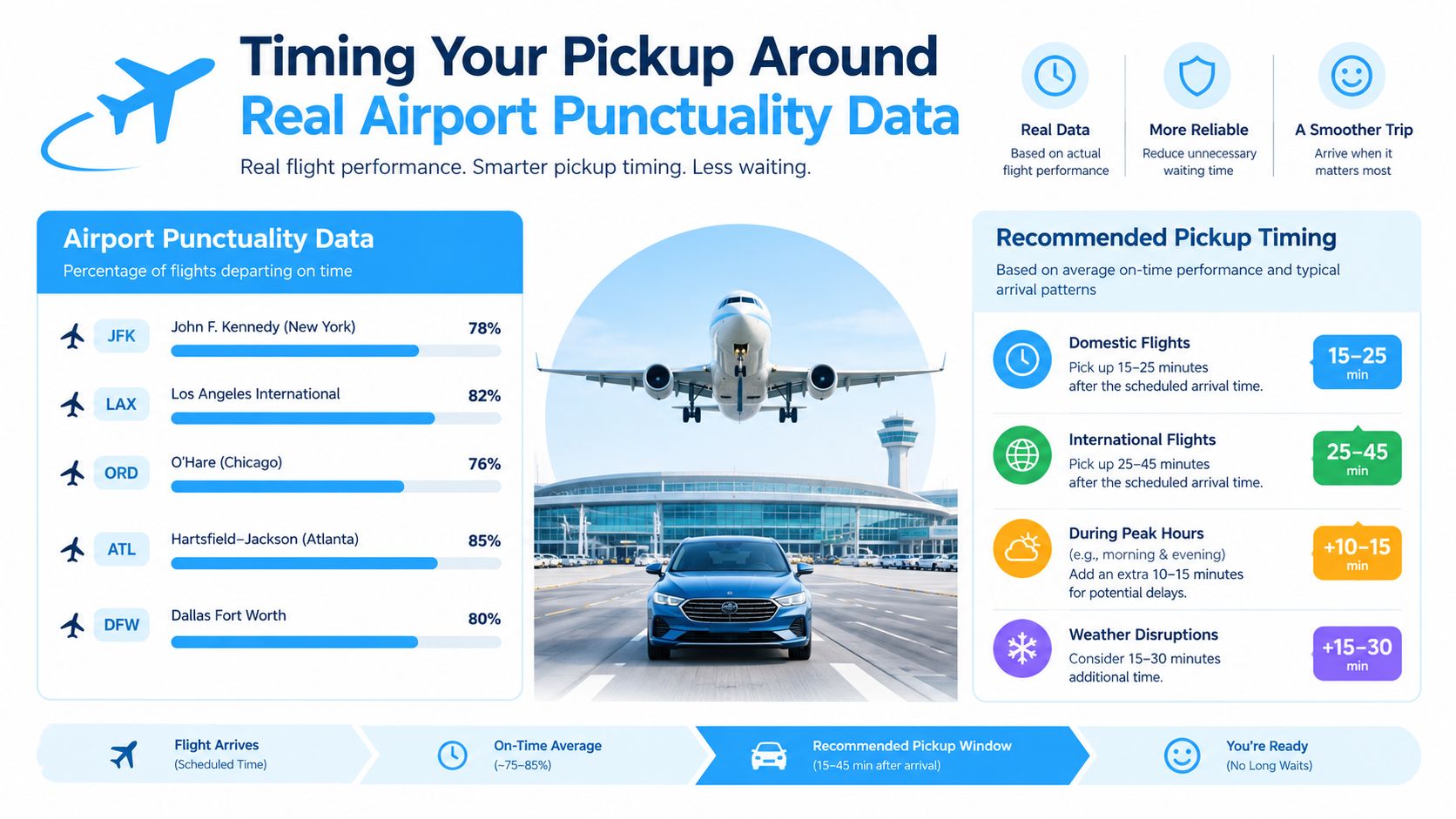
Civil Aviation Authority punctuality data and 2025 analysis show Leeds Bradford averaging about 15 to 16 minutes delay, while Manchester was among the least punctual major UK airports with roughly 63.1% of flights on time and an average delay near 19.9 minutes. More broadly, only about two-thirds to three-quarters of flights at major UK airports consistently fall inside the 15-minute on-time window. The operational lesson is clear: narrow transfer margins fail easily. Those figures come from the CAA punctuality analysis and linked reporting summary.
The timing method that works
Start with your airport deadline, not your departure time.
If you're checking bags, travelling with children, or using a busy terminal, your real target is the point by which you need to be at the terminal and moving in the right queue. Once that's fixed, build backwards in layers:
- Terminal and check-in requirement
- Airport delay profile
- Road variability from York
- Extra handling time for bags, mobility needs, or group travel
That approach is more reliable than saying, “The drive usually takes about an hour.”
Airport Delay Profiles and Recommended Buffers
| Airport | Average Delay | On-Time Performance | Recommended Buffer |
|---|---|---|---|
| Leeds Bradford | About 15 to 16 minutes | Typically below the best-performing UK airports | Add a meaningful airport delay buffer before finalising pickup |
| Manchester | Near 19.9 minutes | Roughly 63.1% on time | Build a larger margin and avoid tight scheduling |
| Other major UK airports | Varies | About two-thirds to three-quarters within the 15-minute on-time window | Don't rely on the published departure time alone |
What this means for York passengers
York travellers often underestimate how fast small delays stack up. You leave a bit later because the road looked clear. Drop-off takes longer because there are bags. The terminal approach slows down. Then the airport itself isn't running cleanly.
That's why a proper York airport booking should be timed with margin, not optimism. If you're specifically weighing the Leeds Bradford run, this page on York to Leeds Airport transfers shows the sort of route-specific service information worth checking before you set your pickup.
Leave room for one thing to go wrong. On airport runs, one thing usually does.
A simple decision test
Your pickup time is too tight if any one of these would break the journey:
- A modest airport delay pattern
- Slow terminal access
- Extra time unloading luggage
- Brief road disruption on the route out of York
If one small setback means you're suddenly late, the booking window wasn't realistic.
Choosing the Right Vehicle for Your Journey
A lot of airport trouble starts before the car even arrives. The wrong vehicle booking creates cramped luggage loading, delayed departures and awkward last-minute changes.
For local work, people often book by habit. For airport work, book by load and use. A solo traveller with one suitcase doesn't need the same setup as a family heading off with pushchairs, hold bags and hand luggage.

Match the car to the job
The cheapest available car isn't always the cheapest outcome. If the boot is too small or the seating is wrong, the delay lands on you.
Vehicle Options for Airport Transfers
| Vehicle Type | Passenger Capacity | Luggage Space | Best For |
|---|---|---|---|
| Standard saloon | Smaller groups | Moderate | Solo travellers or couples with lighter luggage |
| Estate vehicle | Smaller groups | Higher than a saloon | Travellers with bulky cases, prams or extra bags |
| Executive car | Smaller groups | Varies by model | Business travel, client pickups, quieter ride expectations |
| Minibus or larger people carrier | Larger groups | Higher overall capacity | Families, group bookings, or passengers travelling together with multiple bags |
Common booking mistakes
- Booking by passenger count only: Four passengers can still need more than a standard saloon if each person is travelling with full luggage.
- Forgetting special equipment: Child seats, foldable wheelchairs and sports kit need to be declared in advance.
- Ignoring return-leg differences: Outbound and inbound luggage loads aren't always the same.
A good operator will ask follow-up questions instead of accepting the first car category you click. That's a positive sign, not an upsell.
What to ask when you choose
Use plain language. Tell the operator how many passengers you have, what luggage you're carrying, and whether anyone needs assisted boarding or a child seat. If there's an extra stop to collect another traveller in York, say so at booking stage.
One local option in this category is Elite 100 Station Taxis York, which states that it handles airport transfers, executive vehicles, local and long-distance journeys, and bookings by phone, online or app. That kind of multi-channel setup can help when you need a standard car for one trip and a larger or executive vehicle for another.
A vehicle that is slightly too large is rarely a problem. A vehicle that is slightly too small becomes a problem immediately.
What to Expect During Pickup and Drop-Off
The best airport transfer feels uneventful. The details are organised, the driver arrives where expected, the luggage goes in quickly, and the airport handover is calm.
That usually comes down to what was agreed before the day of travel. Good operators don't improvise the critical parts. They confirm address details, pickup time, terminal, passenger name and any notes that affect loading or access.

Before the car arrives
For departures from York, the process should be simple:
- Booking confirmation: You should know the date, time, pickup address and airport destination.
- Contact route: You should know whether updates happen by phone, text or app.
- Special notes: Extra luggage, child seats, access instructions or additional pickups should already be on the job.
For arrivals back into the UK, a proper airport transfer near me search should lead you to operators who can cope with the messy bits, not just the easy ones.
What good pickup looks like
At the pickup point, the driver should know who they're collecting and what the job involves. If you've booked correctly, there shouldn't be a boot-space debate on the driveway.
On drop-off, the strongest operators don't stop at the airport boundary and leave you to sort it out. They plan around the correct terminal and allow for unloading time.
If a firm can't explain how they handle late landings, changed flight numbers or terminal swaps, they're only equipped for perfect days.
When flights are disrupted
Generic guides usually fail people. Real airport travel includes diversions, rebooked flights, missed connections and terminal changes.
A useful rule is to ask in advance what happens if your flight lands at a different airport or a different terminal from the one originally booked. That matters because recent UK disruption has shown how quickly one issue can affect multiple airports. The practical gap in most airport-transfer advice is exactly this kind of disruption planning, which is why this discussion of UK travellers facing renewed chaos after an ATC-related glitch is relevant as a reminder of what passengers face.
Good handling usually includes:
- A clear method for updating your booking
- Operator-controlled reallocation if the airport changes
- Traceable dispatch communication
- A booking record that can be amended without confusion
Bad handling sounds like this: “Call us when you land and we'll see what's available.”
That's not an airport plan. That's starting again under pressure.
Building Your Airport Transfer Booking Checklist
A reliable airport run from York isn't one decision. It's a chain of small decisions that need to line up. When people say an airport transfer went smoothly, what they usually mean is that nobody left the important parts to chance.
Use a repeatable checklist. It saves time and removes the last-minute mistakes that tend to happen when you're packing, working, or trying to get everyone out of the house.
The pre-booking checklist
- Confirm the flight details: Check the airport, terminal, airline timing and whether you're booking departure, arrival or both.
- Verify the operator setup: Confirm operator, driver and vehicle licensing before you pay.
- Set the pickup window properly: Base it on your airport deadline and a sensible margin, not on ideal traffic.
- Choose the vehicle by luggage load: Don't count seats only. Count bags and special equipment too.
- State special requirements early: Child seats, assisted boarding, extra pickups and oversized items need to be on the booking.
- Check the disruption process: Ask how flight changes, terminal swaps and delayed arrivals are handled.
The post-booking checklist
Once the booking is made, a second pass matters just as much.
- Save the operator contact details somewhere easy to reach.
- Keep the booking confirmation accessible.
- Recheck pickup location wording the night before travel.
- If you're returning to York, make sure the flight number attached to the job is correct.
- Know the cancellation or amendment process before you need it.
For people who prefer digital booking and update tools, comparing app-based options can help. This guide to the best taxi app options in the UK is useful if you want to see how app workflows differ from phone and web bookings.
A working final sense-check
Ask yourself three things before you close the booking tab:
- Do I know who is responsible for this job
- Do I know why this pickup time is safe
- Do I know what happens if the travel plan changes
If the answer to any of those is no, the booking isn't finished yet.
York airport transfers don't need to be stressful. They need to be organised. That's the difference.
Elite 100 Station Taxis York provides round-the-clock airport transfers from York, along with local, executive and long-distance journeys, with booking available by phone, online and app. If you want a York-based operator that can handle timed departures, return pickups and changing travel plans with a clear booking process, visit Elite 100 Station Taxis York.