


The first message usually lands before dawn. A director's flight from Manchester Airport has moved earlier, two suitcases need loading, and the assistant booking the car wants one thing above all else, no surprises between York and the terminal.
That is why a York to Manchester Airport Taxi should be treated as a timed corporate transfer, not a casual fare. On this corridor, reliability is the product. The route is long enough for motorway variability to matter, and the airport itself says York is about 83 miles away with car journeys typically taking just under 2 hours. Independent route planners put the road distance at roughly 76 to 77 miles, with driving times around 1 hour 32 minutes to 1 hour 40 minutes depending on conditions, while rail and coach are materially slower in normal journey times. Manchester Airport travel guidance for York
If you book this route weekly, you already know the question isn't “What's the cheapest car?”. It's “Which operator will protect the schedule, the traveller's confidentiality, the client impression, and the budget line?”. That is the standard I use when I organise long-distance airport transfers for York-based teams, and it's the standard I expect from a serious supplier. For context on the operator behind this kind of service, see Elite 100's about page.
Table of Contents
- Introduction Why Corporate Transfers Need More Than a Standard Taxi
- Understanding Corporate Chauffeur Services Beyond Standard Rides
- Key Aspects That Define a Business Grade Airport Transfer
- Contracting Billing and Service Standards Explained
- How to Set Up a Corporate Account With Elite 100
- Confidentiality Duty of Care and Contingency for Airport Travel
- Next Steps to Secure Reliable York to Manchester Airport Transfers
Introduction Why Corporate Transfers Need More Than a Standard Taxi
A 4am pickup for Manchester Airport exposes every weak point in a transport arrangement. The traveller is half awake, the luggage is heavier than expected, and the last thing an executive assistant wants is a driver arriving late, turning up in the wrong vehicle, or asking for clarification at the kerb while everyone else is already thinking about check-in.
Corporate airport work has to be managed like a service agreement. York to Manchester Airport is long enough for traffic, timing drift, and last-minute passenger changes to affect the whole schedule. That is why the corridor needs fixed standards, not casual pricing. The route-planning details for York to Manchester show the scale of the transfer and why buffer time matters.
The question for a business booking is simple. Who protects the schedule, keeps billing tidy, and handles passenger information with discretion? That means the office manager needs clean invoicing, the executive assistant needs confirmation that holds, and the travel coordinator needs one supplier that behaves the same way every time. A corporate transfer has to fit the process, not force extra admin into it.
Practical rule: if a transfer affects a flight, treat the booking like part of the trip's risk control, not a transport afterthought.
That is the lens used here, and it is the right one for repeated airport work. Elite 100's about page sets out the sort of supplier profile that matters on this route, where reliability, billing controls, and confidentiality all affect the result.
Understanding Corporate Chauffeur Services Beyond Standard Rides
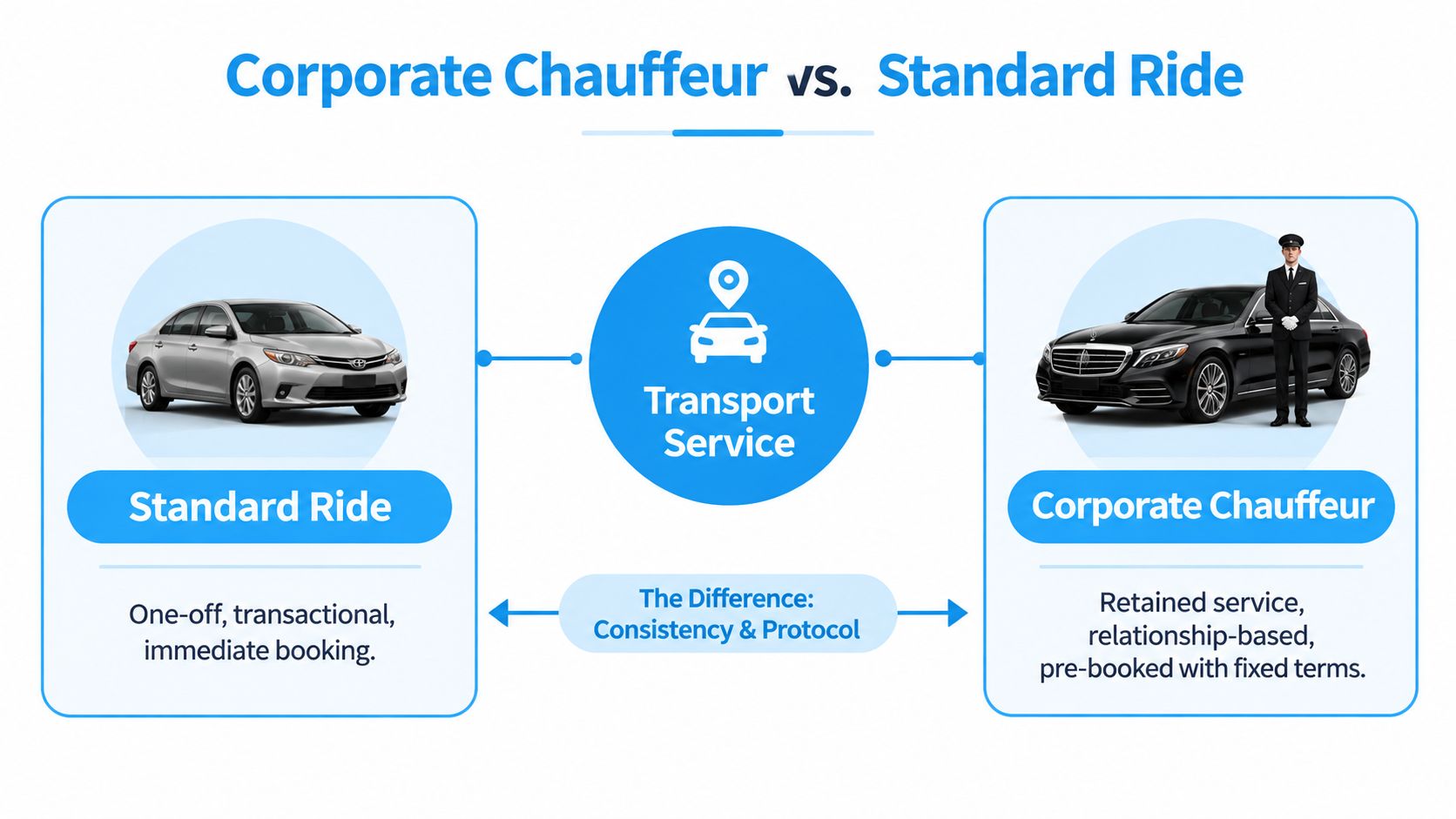
A standard taxi gives you a vehicle and a driver. A corporate chauffeur service gives you a managed relationship. That difference sounds subtle until you're dealing with regular airport runs, where consistency, presentation, and process matter as much as the ride itself.
A one-off ride is a spot purchase. A corporate arrangement is more like a retained supplier. You are not just buying a journey, you are buying predictable conduct, booking discipline, and a known standard of vehicle and communication.
What changes in practice
The first shift is fleet choice. Business travel often needs executive saloons, estate cars for luggage, or other suitable vehicles matched to passenger and bag count. The second shift is the driver. A corporate chauffeur arrangement depends on licensed, vetted professionals who understand that airport work is time-sensitive and client-facing. The third shift is the workflow, because quotes, bookings, and receipts need to be handled digitally so nobody is chasing paperwork after the trip.
That matters more on a long corridor like York to Manchester Airport than it does on a short local run. When the journey stretches across motorway traffic and a passenger has a flight to catch, the service model has to reduce friction at every point. Elite 100's published service model includes round-the-clock availability, digital booking options, and secure payments, which is exactly the kind of operating backbone that makes corporate travel easier to control.
The image below makes the distinction plain.
Why the retained model works better for airport work
A corporate chauffeur service also changes how the office handles exceptions. If a flight shifts, if a meeting overruns, or if the passenger's pickup details change, a retained service can respond inside the same relationship rather than starting from zero. That creates continuity, and continuity is what protects budgets and reputations.
A business-grade transfer is judged less by the car on the day and more by whether the car, driver, and paperwork all behave the same way every time.
For teams that want to formalise the relationship, Elite 100's service standards page is a useful reference point for the kind of service behaviour to expect from a professional operator.
Key Aspects That Define a Business Grade Airport Transfer
A business-grade York to Manchester Airport transfer is judged by control, not by the cheapest quote. If the office cannot trust the pickup, the billing, and the handover of passenger details, the fare is irrelevant.
The four decision criteria that matter
Punctuality discipline comes first. For airport work, “on time” means the driver is ready, the car is positioned properly, and the schedule is protected from the start.
Luggage handling comes next. Airport transfers carry people and bags, not just passengers. The vehicle has to fit both without forcing a compromise at the kerb.
Vehicle presentation matters because this route is often used for executive movement, client visits, and staff travel with a professional standard attached. A clean, appropriate car reinforces that the trip has been handled properly.
Communication and contingency decide whether the service holds up under change. A provider should confirm bookings clearly, keep the office informed, and manage disruption without making the traveller repeat the same details to multiple people.
The comparison below sets out the difference in practical terms.
| Feature | Ad Hoc Booking | Contracted Corporate Account |
|---|---|---|
| Booking method | One-off calls or last-minute app requests | Pre-agreed process and scheduled allocation |
| Price control | Variable and harder to forecast | Clearer commercial terms and easier budget tracking |
| Accountability | Depends on the individual booking | Built into the relationship and service standards |
| Service recovery | Usually reactive | Better structured for rebooking and change handling |
| Office workload | More manual follow-up | Less admin and fewer ad hoc decisions |
| Traveller experience | Can vary from trip to trip | More consistent across repeat journeys |
What finance teams should look for
Finance teams should care about the full admin picture, not just the headline fare. A cheap booking that creates rework, delayed invoicing, or repeated corrections costs more than it saves. A contracted corporate chauffeur arrangement gives the office a cleaner record, especially when the same airport transfer is booked across departments or for different travellers.
Given the corridor length discussed earlier, judge providers on reliability rather than headline price. A business booking for this route needs a predictable pickup, a clear paper trail, and a service standard that stays consistent from one journey to the next. For route context, Manchester Airport's own York page is here, and it supports the same point. The transfer has to be assessed on whether it protects the schedule, not on whether it looks cheap at first glance.
Contracting Billing and Service Standards Explained
Corporate travel falls apart when the commercial terms are fuzzy. If the booking process is clear but the billing is messy, or the price is attractive but the service standard is undocumented, the office ends up paying in admin time and avoidable friction.
What a usable contract should cover
A proper corporate arrangement should define how bookings are made, how far in advance scheduled trips are released, how changes are handled, and what happens if the passenger is delayed. That is especially important on York to Manchester Airport transfers because this corridor is not a casual drive, it is a fixed-time commitment with a real consequence if the schedule slips.
The standards I look for are straightforward. The pickup window must be explicit. Waiting-time expectations need to be understood before the first journey goes live. Rebooking flexibility should be built in, not negotiated when someone is already under pressure at home or in arrivals. If a provider can't explain those points clearly, the deal isn't ready.
The fixed hourly transport option is useful here because it shows how structured booking can support recurring travel, rather than leaving every journey to a fresh quotation and a separate approval loop.
Billing needs to reduce admin, not add to it
Centralised invoicing is the point of a corporate account. The office should not be chasing separate receipts from individual travellers, then reconciling each airport run manually. Digital payments and electronic receipts make expense tracking cleaner, and they also help with audit readiness.
That's where a local York dispatch structure helps. When the supplier is close to the booking team, there's less handoff confusion, especially for early-morning airport runs or late-night returns. Elite 100's published strengths include flexible scheduling, discounted airport transfer pricing, and local York support, which are the right kinds of features for a route that gets booked repeatedly rather than once.
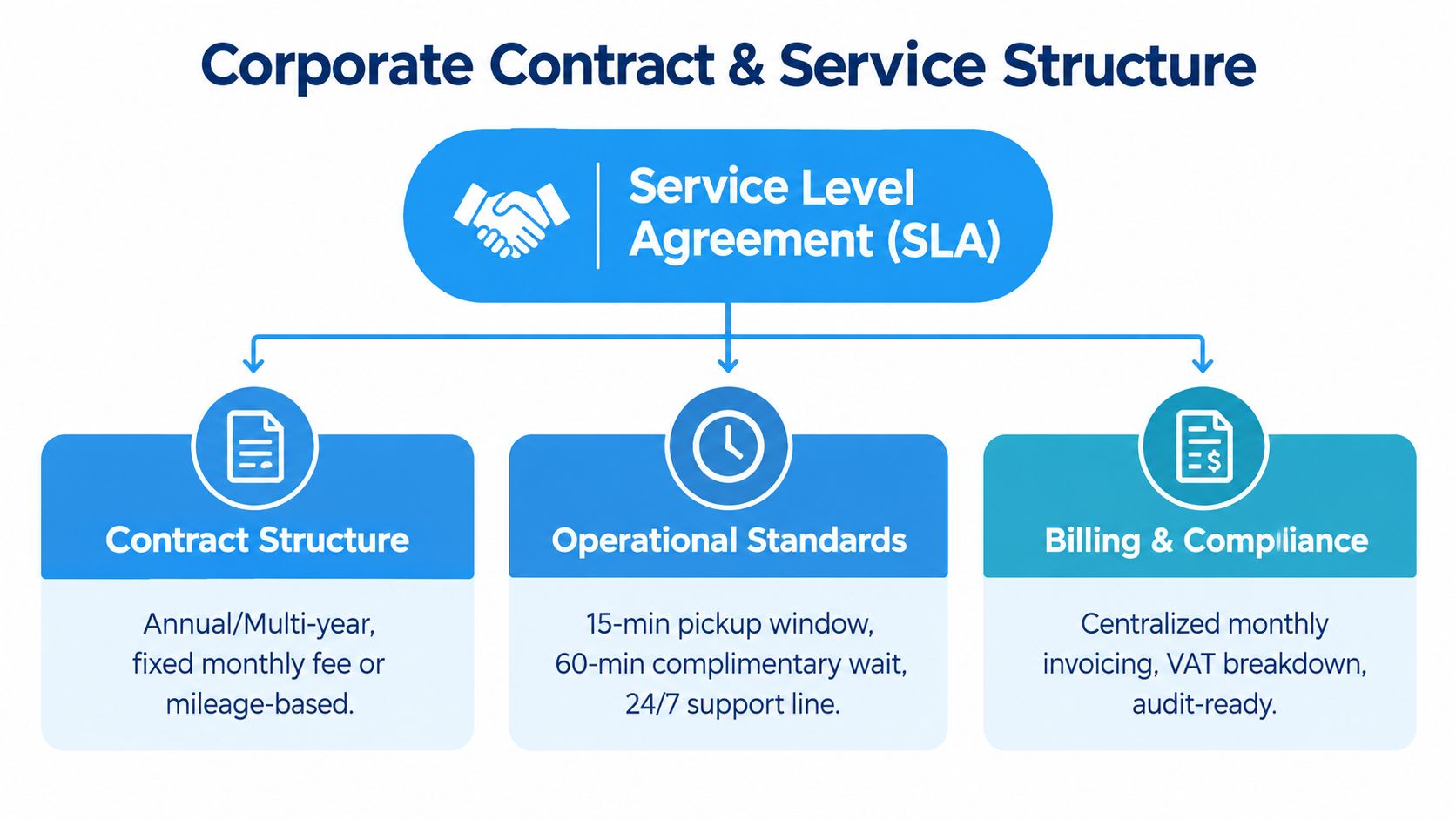
Commercial rule: if the supplier can't explain the SLA in plain English, the finance team will end up interpreting the contract after the first problem.
A good corporate transfer agreement makes the cost visible and the service repeatable. That's the actual value, not the promise of a cheaper ride.
How to Set Up a Corporate Account With Elite 100
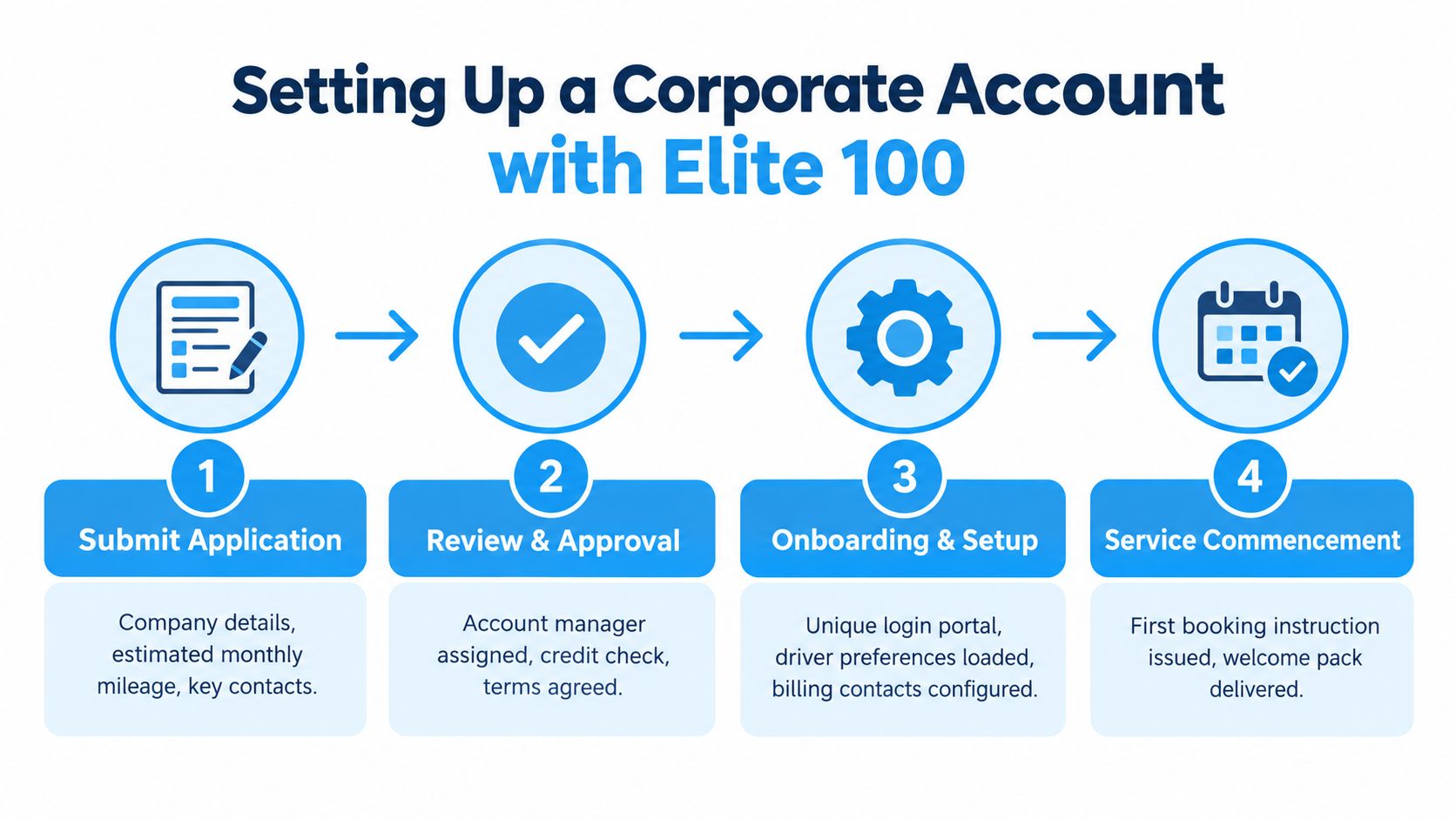
The easiest way to set up a working account is to treat onboarding like a travel process, not an IT project. Start with the practical details, keep the user list tight, and make sure the booking channel matches how your team works.
Start with the company basics
The supplier will need the business details, the main billing contact, and the people allowed to book. If your office books airport transfers for multiple travellers, identify who can create journeys, who can approve them, and who needs invoice access. That avoids the usual confusion where three people think someone else has already confirmed the pickup.
For York organisations, the booking flow is straightforward. Elite 100 supports online booking, mobile app booking on iOS and Android, and phone dispatch via [01904 400 400](tel:01904 400 400). That gives you enough flexibility to handle planned travel and urgent changes without making staff learn a complicated system.
Load the workflow before the first trip
The second step is operational. Put the common travel patterns into the account from the start, especially airport departures, return legs, and recurring executive visits. If your passengers regularly move to Manchester Airport, align the pickup instructions with the flight time, terminal, and bag volume so the driver arrives with the right vehicle and the right expectation.
The point is to remove ambiguity before it appears. A corporate account should let you assign scheduled vehicles, keep permissions tidy, and store travel preferences where dispatch can see them. That reduces the number of messages your office has to send on the morning of travel.
The process flow below is the cleanest way to think about it.
Test the account before volume builds
Don't wait until a full diary week to discover a weak booking path. Send one pilot booking, check the confirmation, check the receipt format, and confirm the traveller experience from pickup to drop-off. If the first trip is smooth, the account is ready for repeat use.
Elite 100's digital workflow for quotes, bookings, and secure payments is the right kind of setup for this kind of test. You want a process that stays light for the office and predictable for the traveller. Once that's in place, the account becomes a tool, not another admin burden.
Confidentiality Duty of Care and Contingency for Airport Travel
A corporate airport transfer isn't only about moving a person from A to B. It also carries a duty of care, because the traveller may be handling sensitive calls, laptop work, itinerary changes, or client information on the move. The cabin has to feel private enough for actual business use.
Confidentiality is part of the service
For executives, consultants, and client-facing staff, the transfer often becomes a working space. That means the driver's conduct matters. Vetted, licensed professionals and maintained vehicles are not just safety features, they're trust features. They let the passenger make a call, review a deck, or talk through a meeting without the journey feeling exposed.
Contingency matters more on this corridor than people admit
York to Manchester Airport sits inside a wider network that can fail in more than one place. Rail disruption can force last-minute fallback decisions, and airport operations can add another layer of uncertainty. National Rail has reported cases where Manchester Airport corridor engineering works and incidents affected York to Manchester Airport services, including an overnight service scheduled to terminate at Manchester Victoria, and a separate incident that blocked all lines between Manchester Piccadilly and Manchester Airport. National Rail's disruption notice for the Manchester Airport corridor shows why passengers need a back-up plan, not just a train ticket.
Manchester Airport disruption is a separate issue. National Rail also noted a later incident that blocked all lines to the airport, and the airport experienced broader fragility during a nationwide air-traffic outage that caused more than 1,000 flight cancellations across the UK. Manchester Airport service disruption notice gives the local surface-access context, while the wider incident demonstrates why airport travel planning can't rely on a single layer of timing.
The practical answer is buffer and fallback
The right approach is to build a buffer into the booking and keep a fallback vehicle path ready if the traveller's first plan collapses. That matters for early departures, but it matters just as much for late arrivals when rail is the weak point and the passenger still needs to get home safely.
If a transfer can't absorb one disruption, it isn't a proper business travel plan.
Elite 100's round-the-clock availability and responsive rebooking are relevant here because contingency is rarely needed during office hours. It usually appears when everyone else has gone home.
Next Steps to Secure Reliable York to Manchester Airport Transfers
Stop treating Manchester Airport runs as isolated bookings. If your team uses the route more than once in a while, a contracted account gives you cleaner billing, a steadier service standard, and far less risk around late changes.
Use a simple checklist. Confirm how often the route is booked. Set the pickup window, waiting expectations, and rebooking rules. Centralise invoicing so finance isn't rebuilding the journey history from scattered receipts. Then test the booking flow once before you rely on it for a critical flight.
If you want the York-to-airport journey to behave like a managed business service, that's the right place to start. Elite 100 Station Taxis York handles local and long-distance transfers, executive travel, and airport pickups with digital booking and secure payment options, so the setup can fit a corporate workflow instead of fighting it. Visit Elite 100 Station Taxis York to open a corporate discussion and put your Manchester Airport transfers on a proper footing.